Vitrimob

Circular Composite Materials for Automotive Lightweighting

Vitrimob develops innovative vitrimer-based composite materials for sustainable lightweighting in the automotive sector. By combining high performance, recyclability, and digital lifecycle data, the project creates new opportunities for resource-efficient and circular vehicle components.

Details

Motivation

The automotive industry faces the challenge of combining lightweight construction with a circular economy. Lightweight vehicle construction is dominated by high-performance plastics that are difficult to recycle, or by plastics that are easy to recycle but less durable.

Vitrimers, as a new class of plastics, combine these properties; however, there is currently a lack of systematic understanding of the relationships between material development, processing, component properties, and recyclability. A data- and AI-driven approach is needed to capture these relationships and ensure value retention throughout the product life cycle.

Goals and Approach

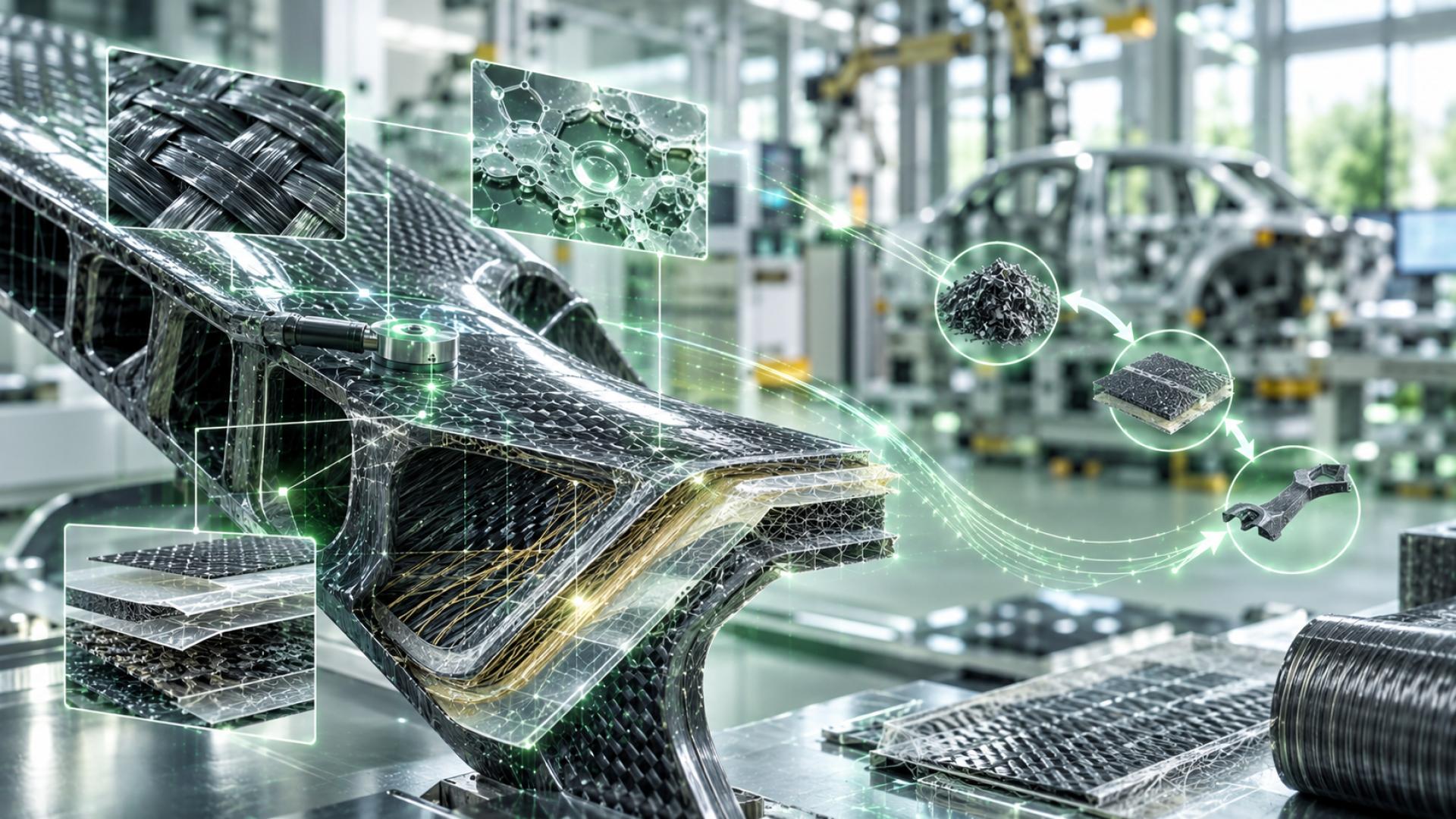
The goal of the Eureka research project Vitrimob is to develop and validate fiber-reinforced vitrimer composites (vitrimer FRPCs) that meet the requirements of industrial mass production and enable circular value creation.

To this end, process and life-cycle data are digitally collected and analyzed. Based on optimized vitrimer FRPCs, performance is investigated in a hybrid laboratory and production environment using a demonstrator. At the same time, an IoT-based data infrastructure is being developed that captures material and process data in real time, integrates AI models for quality and defect prediction, and maps this information in a digital twin and product passport (DPP). The resulting life-cycle metrics enable direct transfer to industrial mass production.

Innovations and Prospects

The project is laying the foundation for the first-ever use of recycled carbon materials in demanding applications. While this is already state-of-the-art in automotive engineering, the technology is an absolute novelty in the aerospace industry.

This example aims to demonstrate that even reused, recycled materials can meet high standards. The project results will facilitate the direct transfer of this technological development into mass-production applications. Furthermore, opportunities will arise to expand the range of applications to other industrial sectors such as rail transportation or the defense industry, for example, due to the improved, higher fire resistance rating of these new materials.

Acronym

Vitrimob

Project Type

Eureka Collaborative Project

Project Period

01 September 2026 to 30 April 2029

Sector / Application Area

Automotive Industry, Lightweight Construction

Topics

Vitrimer Composites, Lightweight Materials, Circular Economy

R-strategies

Refurbish, Remanufacture, Recycle

CircularGlowUp
Funded by the Federal Ministry of Research, Technology and Space